
FLOWERX 2027 ·
Why you shouldn’t miss FLOWERX
When the lights go down at ROMEXPO on 24 January, some of the ideas you will see in spring will already be on their way to florists’ studios. At FLOWERX, you can be there as they take shape.
23–24 January 2027 · ROMEXPO, Pavilion C2 · Bucharest
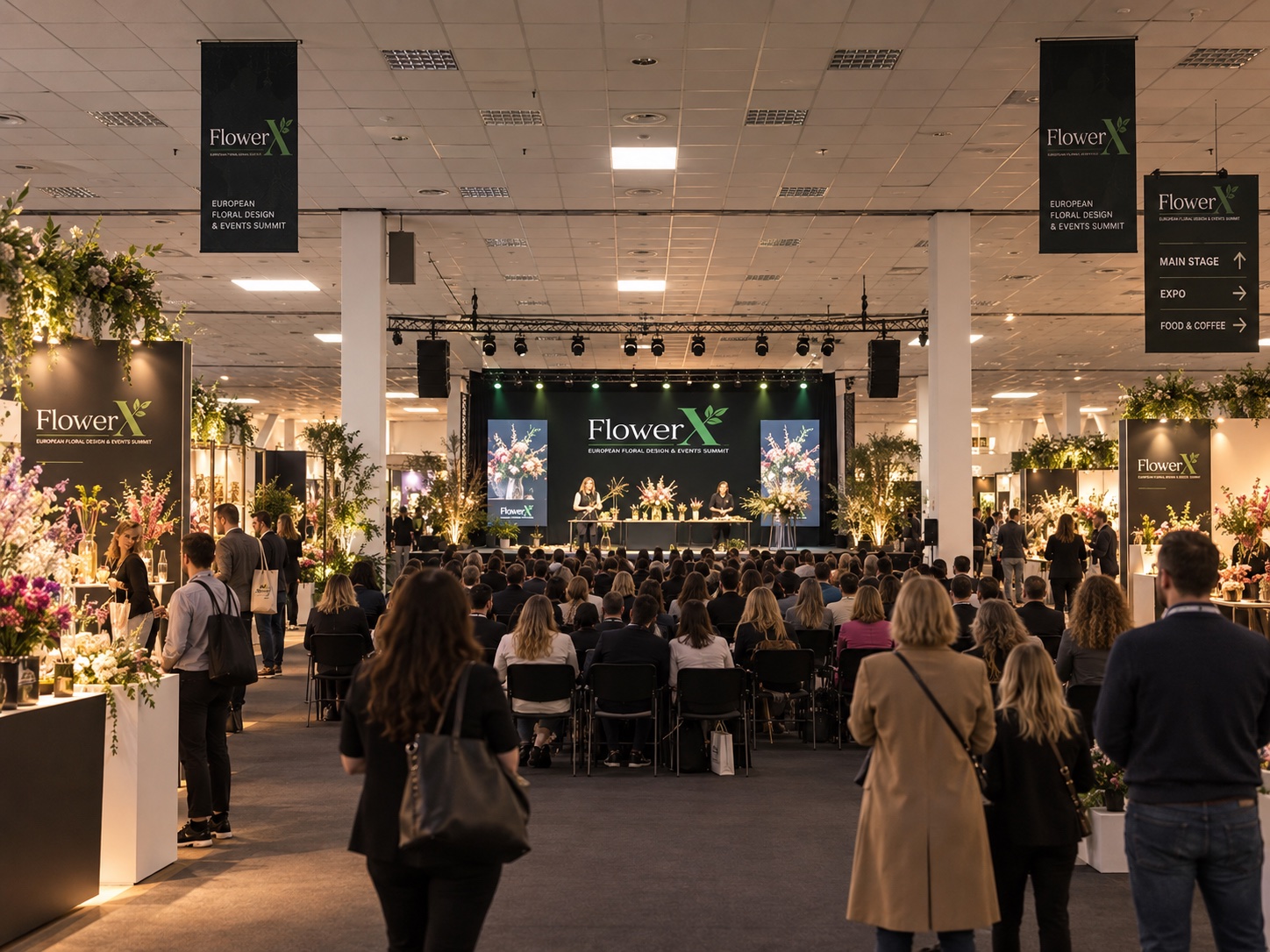
The sketch looks flawless on screen. The client has said yes. Then you walk into the venue. The ceiling is lower than it looked in the photographs, the installation has to come through a narrow passage and there aren’t enough stems of the flower you planned to use. For a florist, this is where the project really begins. What do you keep? What do you change? Who do you call?
FLOWERX 2027 brings those questions into one room with the people who grow, supply, design and build. On 23–24 January, at ROMEXPO’s Pavilion C2 in Bucharest, you can go from examining a supplier’s product to watching an installation designed to be seen across an entire hall. On 22–23 January, before and alongside the first public day, Preston Bailey leads a separately ticketed Masterclass on the creative and business decisions behind premium events.
Bring a project already on your desk. A restaurant installation that needs refreshing every week. A wedding brief you’ve accepted and still need to work out how to deliver. A spring display for customers who want plants they can choose and care for easily. Give the trade show a real question and the stands become places to get work done.
Watch the original on Reels
What you see at the Expo when you start with a real order
Imagine preparing 24 table centrepieces. Two varieties may look interchangeable in a photograph. Side by side, you can see what each stem contributes, how much needs trimming, how the shades read under warm light and how quickly the team can work with each variety. One may look spectacular from thirty centimetres away. The other may carry its colour much better across a room.
Bring the photo of the space and a short list of what you have to order. Ask who is responsible for availability, how far in advance the quantity needs to be confirmed and what replacement can be discussed if the season changes. The ten companies in the public exhibitor catalog offer very different starting points. Some help you think about the material, others make you review the way you buy, sell or manage it. Below is the route I would take with sketch in hand.
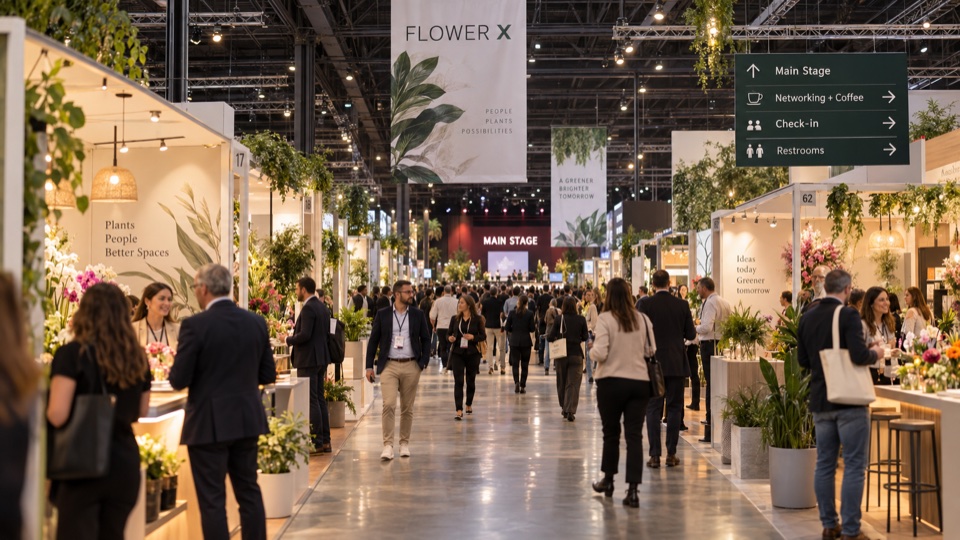
Flowers Market Holland — What does a supply you can rely on look like?
The main partner and organizer of FLOWERX is an importer and distributor from Romania. Its portfolio includes cut flowers, plants, greenery and accessories. For those who run a flower shop, the useful discussion starts with what needs to be restocked week to week and what can be ordered only for a project. Show the bill of materials of a typical order and ask what can be scheduled on a recurring basis. A supplier may have a nice offer and still not be suitable for your work pace. It's better to find out at the stand while you still have time to look for alternatives.
Flowers Market Holland's profile ↗
Waterdrinker — Plants for a florist who wants to sell even after the first purchase
Waterdrinker, the Premium partner in the Netherlands, is a wholesale supplier of plants, cut flowers and accessories, with Green Trade Center in Aalsmeer. In a retail project, the good question does not end at the appearance of the plant. You want to know how it looks after shipping, how easily you explain to the customer how to maintain it, and what sizes make sense in a flower shop with limited space. If you're putting together a seasonal collection, think of it as a shelf that people see in seconds. What makes them stop? What can I take home without needing a car?
TESSA — The rose seen beyond the catalog photo
The grower in Ecuador works with roses, spray roses and other cut flowers from the Andes. If you're sketching an entire table in one palette, look at the bud-to-stem ratio, the shade of the petals, and how a larger flower changes the number of stems needed. It pays to have two options ready. One for the main moment, where the client will see the detail up close, and one for the areas where you need to keep the color on a larger surface.
OZ-Hami — The backup plan for the flower in the sketch
The Dutch cut flower exporter works with growers, wholesalers and florists and tailors its selection and export services to the market. The best question at the stand goes something like this: If the variety I drew doesn't come in the week of the assembly, what can I achieve the same effect with? You can discuss colors, gauges and availability ranges before you find yourself on the phone two days before the event. In Romania, OZ-Hami products are available through Flowers Market Holland. For a specific project, ask how you can check the offer and delivery.
Decorum — The assortment that customers can recognize in your window
Decorum brings together growers from the Netherlands who market their cut flowers and ornamental plants under the same brand. On a florist's list, lilies, orchids or patio plants can have very different functions. Some prepare an event order, others create a retail collection that the customer can buy next time. Discuss what changes with the season and what combinations would work for your audience. Prepare a picture of the showcase. You will receive more concrete answers when the person in front of you knows where and for whom you are selling.
Pro Florist — What happens after the customer says yes
Pro Florist brings a platform for florists to the Expo. Catalog, orders, production and delivery are points where your business can make or lose time by the minute. Think of an order that recently gave your team trouble. Who was the last to know that the address has changed? Who checked if the flowers were available? Who confirmed that the delivery left? A software demo becomes relevant when you run it through your actual flow. Ask to see exactly what step is consuming your time, including what happens if an order changes after the team has started work.
Zetomat — What a sale looks like when the flower shop is closed
The Romanian company introduces automatic flower machines, an option for florists looking to sell bouquets outside of opening hours. The discussion starts from where you could place the device. Who passes by in the evening? Who restocks it? What happens to bouquets that don't sell in your acceptable range? The figures that matter must include supply rate, losses and working time. It's a much better discussion to have next to the product than after you've made a decision about space and investment.
Mzurrie Flowers — Kenya roses and the consistency question
Mzurrie Flowers features roses grown in Kenya. For high volumes it matters how well the palette holds up when you have multiple batches, how uniform the stems look in a repeat composition, and what you can confirm for a given week. If you are preparing an event, bring a picture of the flowers around the rose, not just the rose. Color and texture are judged differently when you know what they will sit next to. Ask for a primary and a backup option. Only then write down what you want to test in the workshop.
Zentoo — How different one chrysanthemum can be from another
Zentoo brings together Dutch growers specializing in cut chrysanthemums. Several shapes, colors and textures in the same category allow you to choose whether the flower holds the structure of the composition or appears as an accent. Think of an arrangement you made recently that required too much material to look good. See what a difference a different bloom shape or a more intense shade would make from a distance. It's the kind of comparison where a few minutes with flowers in hand can change the way you build a bouquet.
Marathon Plants — Ornamental plants grown in Mediterranean conditions
Marathon Plants works with ornamental plants in Greece and has greenhouses in Marathon, Attica, and at Kyparissia. At the stand you can start from the space for which you choose the plants: a terrace exposed to the sun, the entrance to a hotel or a spring collection intended for customers of a flower shop. It says where they will be delivered and how they will be used. Discuss the delivery size and acclimatization conditions you can recommend to the customer. Between what you like today and what you can responsibly recommend for a project is a conversation worth having in person.
Preston Bailey and the Masterclass on January 22–23
Preston Bailey opened his studio in New York in 1980. His portfolio has evolved from floral arrangements to transforming entire spaces through flowers, installations, lighting and scenography. It's easy to stop at the size of a work. The question worth taking with you to the Masterclass is how you go from the idea that impresses a customer to the promise you can produce, evaluate and deliver with your team.
"Mastering the Art of Luxury Events", on January 22-23, is the course dedicated to those who want to build a premium offer. On the first day, the published topics are about your local market, customer, positioning and boundaries of your service. Think of the last deal where you calculated the flowers correctly and underestimated the hours of preparation, coordination or the post-event teardown. How would you describe in the future offer what you are buying and what the customer is actually buying? The difference matters when you sit down with someone who is comparing three providers and still can't see why the proposals cost differently.
The next day goes to brand, team, pricing models and lessons from real projects. For a small studio, this can mean asking very practical questions. Who decides when there is a last-minute change during installation? What costs can be estimated and need to be tracked as you work? What do you promise on behalf of the team when neither the venue nor the number of guests has yet been decided? Bring an offer you want to improve. The assignments make a lot more sense when you can compare them to your own numbers and choices.
The Masterclass has a separate ticket. According to the official page, access includes both course days and access to Expo and Main Stage on January 23–24. The total published capacity is 80 seats, divided between price phases. This is the capacity of the program and current availability can be checked on the ticket page. The first day of the Expo overlaps with the second day of the Masterclass. Those who want both experiences should reserve time for the stands on Sunday as well.

See the assignments and access to the Masterclass ↗
Saturday, from the stands to the Main Stage
The first day of the Expo, January 23, connects the booth area with a program about how the job is changing. In the published schedule, Business of Flowers opens up a conversation about market and value, and Floral Design & Trends Live, scheduled for 2 p.m., moves on to techniques and materials. Later, Future of Flowers brings together growers, retail, technology and artificial intelligence. Look at these moments as stages of the same day. If in the morning you found out what materials can be procured, in the afternoon you can see if they change the way you build your offer.
Take a concrete situation. A florist wants to add a few more expensive bouquets weekly, but the team is already wasting time re-ordering and confirming stock. A supplier can help with regularity of supply. A demonstrator can show which material creates volume with fewer stems. And a discussion of technology may raise the question of whether the same stock is visible for the workshop and for sale. All three observations can be written on the same page. Monday you have something better to take to the team than a list of trends.
Headline Floral Show is scheduled at 17:15. Allow time ahead for returning to the stand where you received an incomplete answer. When you see the same person twice in one day, the second conversation already starts from your project. Tell him what you understood between meetings and what you would like to clarify. It can be a very short exchange. It's enough to find out if it's worth continuing next week.
At the end of the day, check if you have something to take forward. A contact without context is lost among the others. A conversation in which you showed the plan of the space and decided when to come back with quantities has a continuation. On Sunday you can start with the two questions left on the list and leave the evening for the stage.
Sunday on the Main Stage, the decisions the final photograph leaves out
On January 24th, Greg van G presents Signature Floral Show. When watching a demonstration from the hall, you have the freedom not to look where the camera is looking. Watch from the edge of the stage or further away and watch how the outline reads, what shape the composition takes as it grows, and in what order the elements are added. Choose only one decision to follow. When you put too many things in a note, you forget it by Monday. A precise observation about angle or proportion can become a test you repeat in the workshop.

Watch the original on Reels
Also on Sunday, the FLOWERX Floral Design Award live final puts floristry in a situation that every professional knows: you start from a theme and have to make decisions under time pressure. The public program includes a live challenge, presentation of creations and awarding of prizes. Watch as multiple finalists respond to the same theme. Where does the outcome change depending on the materials, and where does it change just because someone has assumed a different form? The names of the finalists are published through the competition. The trailer introduces Dorin Buterez and provides context about the award.
Watch the original on Reels
The Preston Bailey Experience is scheduled for 5:15 p.m. Here you can watch what Bailey's vision means when it is conceived for an audience that sees it from multiple angles, something that is much harder to understand from a gallery of images. If you're interested in event work, check out Sunday's full schedule and leave room to see more highlights on the same day. This gives you the opportunity to compare a contest challenge, an author demo, and an experience built for the stage.
See the current schedule and access to Main Stage ↗
Who else supports FLOWERX
FLOWERX’s media partners approach the event from different angles: News.ro from the news desk, Profit.ro from business, Life.ro from lifestyle, CasaLux.ro from interiors and Casa-gradina.ro from home and garden. For teams travelling to Bucharest, Corinthia Bucharest is the hotel partner and Rentado offers car hire. Sorting out where to stay and how to get to ROMEXPO leaves more of the weekend for the fair, especially if your plan includes an early arrival or the last show on Sunday.
Which ticket is good for you and how do you prepare your weekend?
Expo Pass is for visiting the fair on both days, January 23rd and 24th. Choose it if you primarily want to compare products, meet growers and chat with suppliers about your projects. Full Pass combines Expo and Main Stage on the same two days. It's the right option if you want to connect the materials you see in the stands and the way designers think about them on a large scale. For the intensive course with Preston Bailey, choose the Masterclass access and check the details on the official page.
If you come with a colleague, share an hour. One watches the stage, the other goes with the sketch to the stands. You then meet and write down three things together: what you want to test, where you can get the material, and who you will continue the discussion with. And if you come alone, set one question for each area. You have more to gain from three conversations where you arrive at a concrete answer than from twenty hastily assembled business cards.
What changes when you put cost, design and supply on the same page
Consider two commands. The first is for a florist who repeats the same types of bouquets every week, but loses money when a color sells harder and stays out of stock. The second is for a studio that has only one large installation to build and will buy several categories of materials for a single day. Both teams can start from the same photo. But they need different discussions with suppliers. The florist needs predictability and alternatives for busy days. The studio needs confirmation that is accurate enough for the team to prepare and edit the entire work.
Take your first order and imagine your route to the Expo. You start with a discussion about what varieties can go into a recurring assortment. Then you compare at a grower's stand two forms that can occupy the same place in a bouquet. At a software booth, you show how an order gets from sales to the shop floor and ask where the inventory change would be visible. At the end you have four useful lines to note: what you are testing, how much you order the first time, who sees the order and what happens if one of the varieties is missing. You can start a small test in the workshop while the answers are still fresh in your mind.
The second route starts from the space where you mount the scenery. Bring the plan or at least a photo of the point where guests enter. Talk to the supplier first about materials that need to be confirmed early. At a demo, look at the mounting order and how much the work changes once the first bulking elements are added. Then show your colleague what you observed and see if the structure and materials you could procure support the idea. A decision made at that time can change the estimate, the number of hours you have to spend on preparation and the way you explain the proposal to the client.
There's a good chance you'll be left with an idea even from an exchange that doesn't lead to an order. You may find that a material you use often has a suitable substitute for a particular light. Maybe another florist will show you, in a few words, why he changed the dimensions of a support only after entering the room. Write down the observation along with its context. When you come back to the project after the event, you will also know what conditions the idea fits, not just that you liked it.
How to make three hours at FLOWERX count
In the first hour, go to the booths with one commercial question. Maybe you want to compare roses for a project that repeats itself in multiple locations. You may be interested in how to prepare a spring offer with plants that you can also recommend to an inexperienced customer. Take pictures only where you have permission and note the name of the variety next to the picture. A photo without context quickly loses its value when, two weeks from now, you're trying to remember which booth you left.
In the second hour, choose a moment in the scene and observe how people move around the work. When is the composition first seen? When is the designer's intent understood? What element remains well defined even when viewed from the side? These questions are practical for anyone setting up decorations at the entrance to a hotel, a wedding hall, or a space where the public will pass quickly. You can test the answer in the workshop with a composition much smaller than the one seen on stage.
In the last hour, go back to a person you met earlier. Tell him what you learned in the meantime and what you would change in the draft. Put on the table the question you avoided the first time: what can be confirmed, what must be tried and what comes next if the offer does not cover the whole project? If you have a concrete answer, exchanging contact details becomes the next natural step. When you post after the event, you'll be able to resume the exact conversation you started.
As a team, end the day by choosing one thing you'll test right away and one you still need to compare options for. Notes are easier to use when each observation has an owner and a due date. It's a simple way to make room for new ideas in the midst of already promised orders and phones that will ring again on Monday morning.
On Monday, the same sketch may look different
After the weekend, someone will send you a photograph of the work on stage. You’ll see the result. What you won’t see is how the team chose the height, or why they removed the one element you would have kept. You can’t put a photograph of your own venue on a supplier’s counter and start that conversation. And you can’t go back to the five minutes beside an installation that might have changed what you buy for spring.
On 23 and 24 January, those moments are all in the same place. If a project is still waiting for you at the studio, put the weekend in your diary. Choose the access that gets you to the parts you want to see. Bring the sketch you haven’t sent yet. On Monday, you can open the same file with an idea you’ve seen work and the number of someone who already knows what you’re looking for.
Choose your FLOWERX ticket










 Corinthia Bucharest
 Rentado